🔐 How BetaFair Selects Winners: Our Verifiable Randomness (VRF) System
BetaFair uses a Verifiable Randomness (VRF) system to select winners fairly and transparently. The process is designed to prevent manipulation, ensure equal opportunity, and allow results to be independently verified.
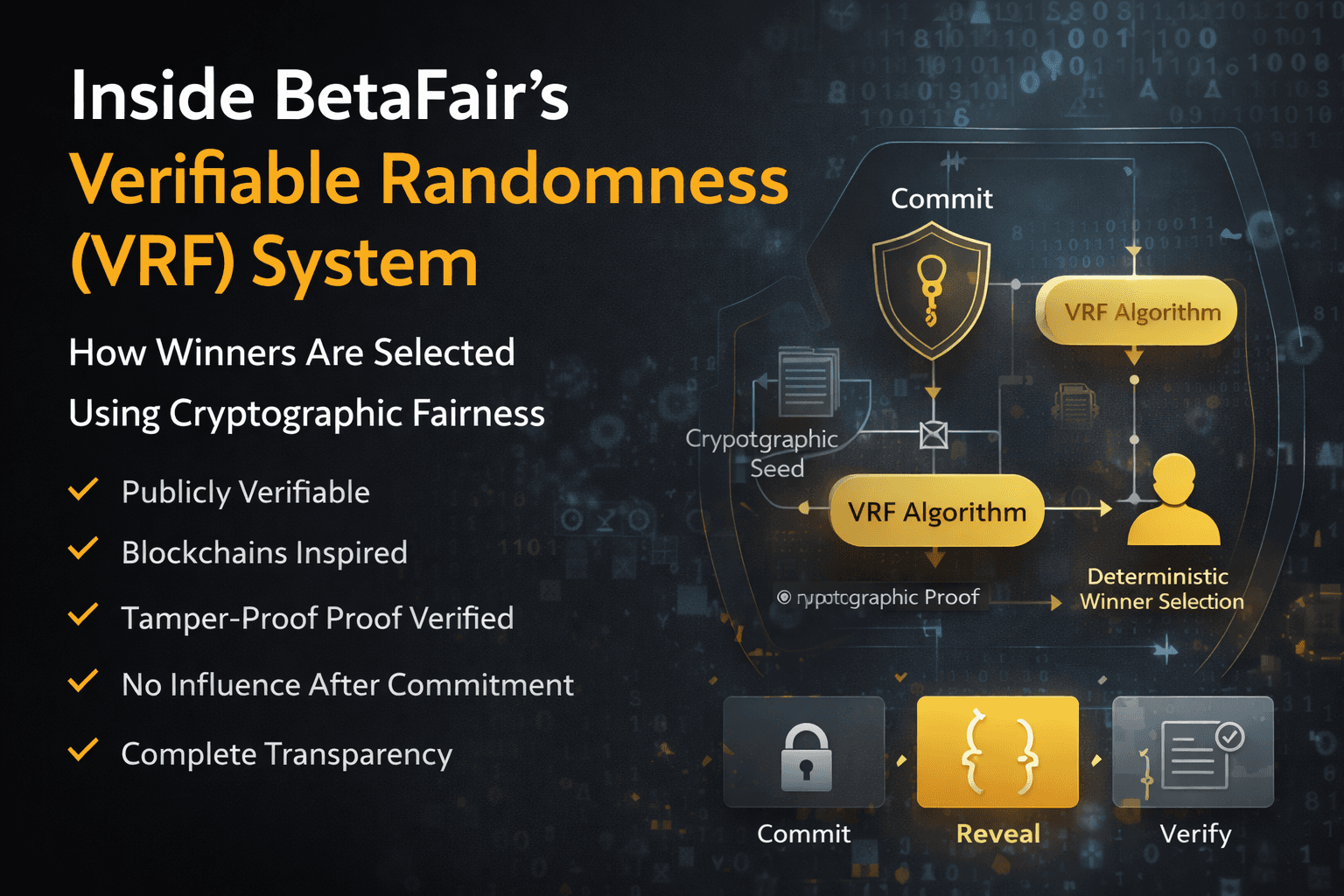
Inside BetaFair’s Verifiable Randomness (VRF) System
How Winners Are Selected Using Cryptographic Fairness
At BetaFair, fairness is not a promise—it is a system design choice.
To ensure that every campaign outcome is protected from manipulation, bias, or human interference, BetaFair operates a Verifiable Randomness (VRF)–based winner selection system. This is the same class of cryptographic technology used in blockchain networks, decentralized protocols, and high-security digital infrastructures worldwide.
This article explains—clearly and transparently—how the system works.
Why Traditional “Random” Systems Fail
Most platforms rely on:
• Manual draws
• Server-side random functions
• Admin-controlled selections
• Opaque algorithms
These systems share one critical weakness: trust is assumed, not proven.
If a system allows an operator to:
– re-run a draw
– adjust entries
– influence timing
– override outcomes
Then the system is not truly fair—it is discretionary.
BetaFair was designed to eliminate discretion entirely.
What Verifiable Randomness (VRF) Really Means
A VRF system produces randomness that is:
• Unpredictable – no one can know the result in advance
• Unchangeable – once generated, it cannot be altered
• Verifiable – anyone can mathematically confirm it was correct
This is fundamentally different from “trust me” randomness.
In a VRF system:
You don’t trust the operator.
You verify the math.
The Core Principle: Commit → Reveal → Verify
BetaFair’s VRF system follows a commit–reveal architecture, inspired by cryptographic protocols used in blockchain and decentralized finance.
1. Campaign Commitment (Pre-Commit Phase)
Before a campaign closes, the system creates a cryptographic commitment.
This commitment:
• Locks campaign parameters
• Locks eligible participations
• Generates a hidden seed reference
• Is recorded internally and cannot be modified
At this point:
✔ No new entries can be added
✔ No entries can be removed
✔ No rules can be changed
The system is frozen.
2. Seed Generation (Entropy Creation)
When the campaign closes, the VRF engine generates randomness using multiple entropy sources, such as:
• Campaign identifiers
• Timestamp anchors
• Participation hashes
• Cryptographic private keys
These inputs are combined to produce a random seed that:
• Cannot be predicted
• Cannot be influenced
• Cannot be regenerated differently
This seed exists only once.
3. VRF Execution (Randomness with Proof)
The seed is passed through the VRF algorithm, which outputs two things:
A random value (the result)
A cryptographic proof (the evidence)
The proof mathematically demonstrates that:
• The random value came from the committed seed
• The algorithm was executed correctly
• No alternative outcome could exist
This proof is what makes VRF superior to ordinary randomness.
4. Deterministic Winner Mapping
The random value is then deterministically mapped to eligible participations.
This means:
• The same input always produces the same winner
• The system cannot “pick again”
• Re-running the process gives the same result
There is no second chance to influence the outcome.
5. Verification & Transparency
Because the system is deterministic and cryptographic:
• The result can be independently verified
• The proof confirms the outcome
• Any manipulation attempt would be mathematically detectable
In simple terms:
If the system was tampered with, the math would not check out.
Why This Beats Conventional Systems
The VRF system used by BetaFair eliminates:
❌ Admin bias
❌ Manual overrides
❌ Timing manipulation
❌ Hidden rerolls
❌ Insider influence
It replaces trust with verifiable certainty.
This is why VRF-based systems are used in:
• Blockchain consensus
• Secure lotteries
• Decentralized governance
• High-value digital allocations
From Selection to Delivery: Closing the Trust Loop
Randomness alone is not enough.
After VRF selection:
• The winner is verified
• Confirmation is published
• Delivery proof is documented
This creates a complete audit trail:
Participation → Selection → Verification → Fulfillment
A System Built for Scale and Scrutiny
BetaFair’s VRF system is designed to withstand:
• Public scrutiny
• Regulatory review
• Partner audits
• Long-term scaling
It is not built for shortcuts.
It is built for credibility.
In Conclusion
BetaFair does not rely on trust, promises, or appearances.
It relies on:
• Cryptography
• Determinism
• Transparency
• Proof